The "Rules and Norms" of Competitive Chess
This article was inspired by the “trial match” on Tuesday 15/9/26 which I am running for new players to competitive chess. If any members (or prospective members) want to take part in this you are very welcome!
When players first move into competitive chess, they arrive with a lot of the same questions: what's actually different here? My first answer is always the same — competitive chess is fundamentally the same game you've been playing with friends, just played with the volume turned up. The intensity is higher, and so is the demand on your concentration. Games run longer, clocks are ticking, and holding your focus for two, three, sometimes five hours is a skill in itself.
On top of that, there's a layer of rules and etiquette that casual chess simply doesn't need. Some of these come straight from the FIDE (International Chess Federation) rulebook and rarely get enforced over a kitchen-table game. Others are just customs — unwritten norms that can catch out anyone arriving fresh from online chess, where a click either works or it doesn't.
Mobile Phones
Phones are a live cheating risk in a way they simply weren't a generation ago — a device in your pocket can out-calculate the world champion. Because of that, the standard expectation is that phones stay off during play. Some competitions relax this slightly, allowing silent mode, or occasionally vibrate if a player is genuinely expecting an urgent call — and if that's the case, tell your opponent up front so it isn't a surprise. But the safest habit, and the one I'd recommend by default, is to switch it off completely and leave it face-down where both of you can see it.
The same goes for anything else with a battery in it: headphones, earbuds, smartwatches — all off, all put away. Plain, non-electronic earplugs or earmuffs are fine if you need to shut out background noise. It goes without saying that silence is expected when serious games are being played!
Starting the Game
A handshake before the first move used to be automatic. Since Covid, not everyone's comfortable with that, and nobody should feel obliged to offer or accept one. What matters more is the acknowledgement — a nod, a "good game," a "good luck." It costs nothing and it sets the tone for the hours ahead.
Touch Move
Here's the one rule that trips people up more than any other: there are no takebacks. Touch a piece of yours on purpose, and you're committed to moving it if it has anywhere legal to go. Touch an opponent's piece on purpose, and you're committed to capturing it if a legal capture exists. Once you've placed a piece on a new square and taken your hand off it, that move is done — no second thoughts.
This is usually the hardest habit to build when moving from casual to competitive play, and juniors feel it hardest of all. I've had real success getting young players to sit on their hands between moves — it breaks the reflex to grab a piece before the thinking is finished.
Castling deserves its own mention, because the order you touch the pieces in genuinely changes what you're allowed to do. Use one hand for the whole move, and always touch the king first. Here's why it matters: if you touch the rook before the king, intent doesn't come into it — the rule doesn't ask what you meant. The instant your hand lands on that rook, it's now governed by ordinary touch-move, on its own, and castling on that side is off the table for this move. If the rook has any legal move available, you're obliged to play it. Get the order right and none of this comes up — king first, then the rook.
The Clock
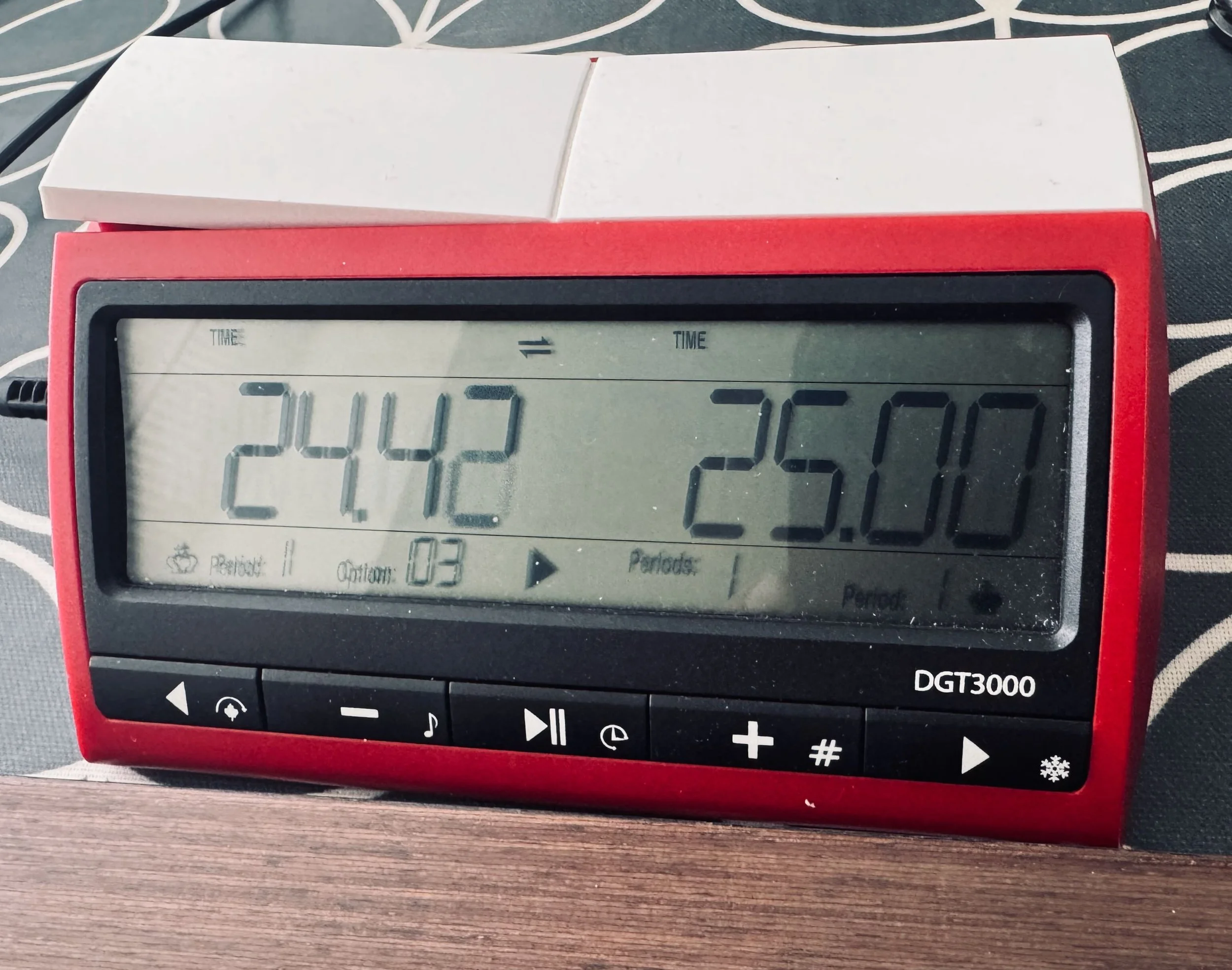
Once you've made your move on the board, press the clock with the same hand you used to move the piece. Don't switch hands mid-motion, and don't hover a finger over the clock waiting to strike — both are against the rules, and arbiters do notice.
Recording the Game
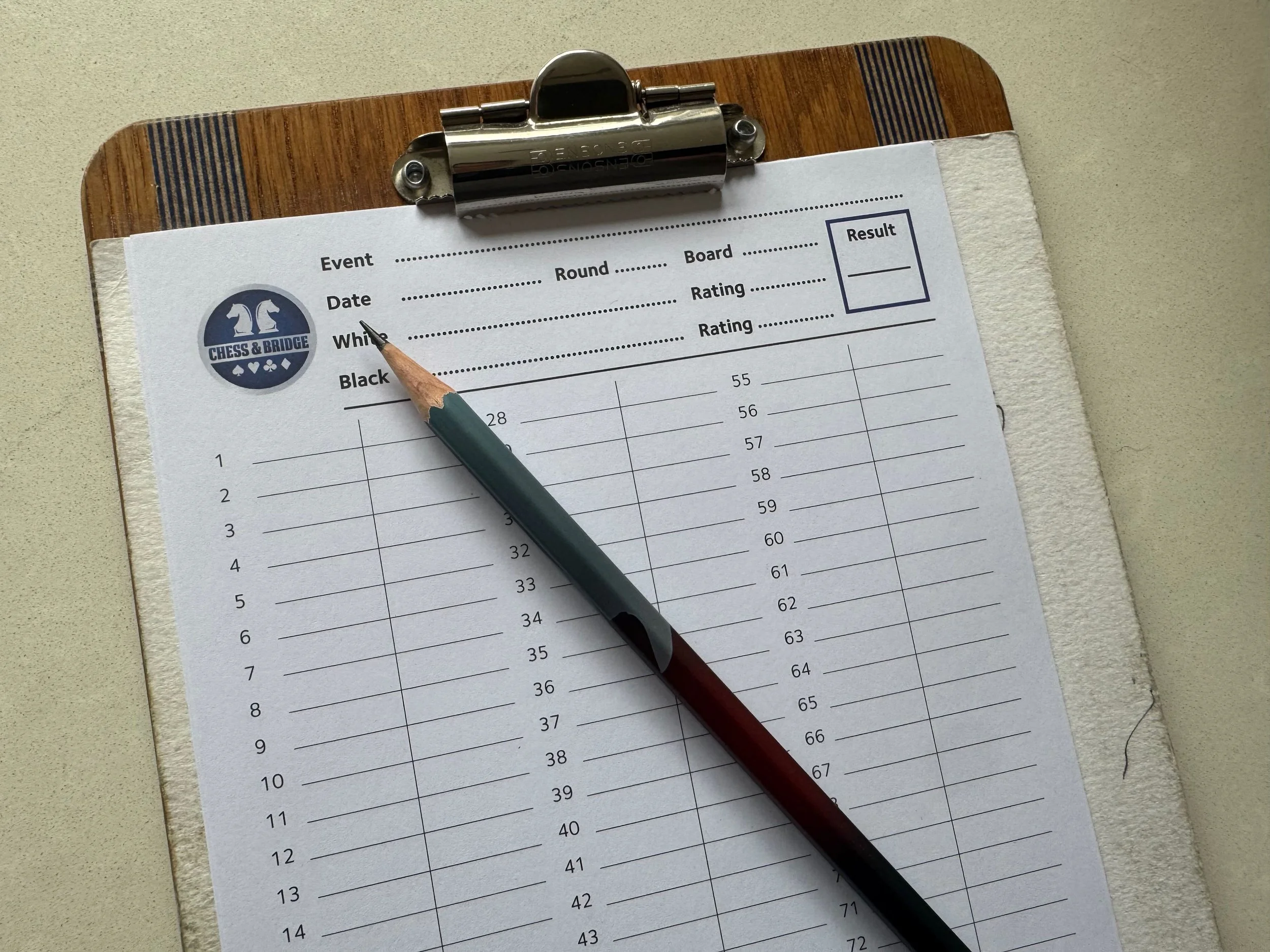
You'll be handed a scoresheet at the start of a competitive game, and it's your job to keep it current — every move, yours and your opponent's, in algebraic notation, move by move. That obligation runs right up until your clock shows under five minutes remaining; after that point you're free to stop recording and put every second into the position in front of you. (This exemption only applies if your time control doesn't add at least 30 seconds per move. With a 30-second (or longer) increment, the clock never gets that tight, so the recording requirement never lifts)
Draws
If you'd like to offer a draw, make your move first, then offer it — not the other way round. Once it's on the table, your opponent can sit with it for a while, accept, decline out loud, or simply play on, which counts as a decline in itself.
In Conclusion
That's the shape of it — a game you already know, wrapped in a few extra layers of discipline: phones off, hands steady, the clock respected, the scoresheet kept, draws offered the right way round. None of it is there to trip you up; it's there so that two hundred people can share a room and trust the same result. Once these habits become second nature, you stop noticing them at all, and what's left is just the chess — the tension of the clock, the thinking, the handshake at the end. I've watched a lot of players make that transition, and almost without exception they come out the other side loving the game more, not less. Competitive chess asks more of you than a casual game ever will, but in my experience it gives back a great deal more too.
Kevin 14/09/26