Open Gambits - A Book Review
George Botterill - Batsford 1986
This is a strange choice for a book review. The book is 40 years old and when published did not make great waves. My personal interest was sparked when I was looking for a theme for a tournament at my local club and my eye fell on it as I was scanning my shelves.
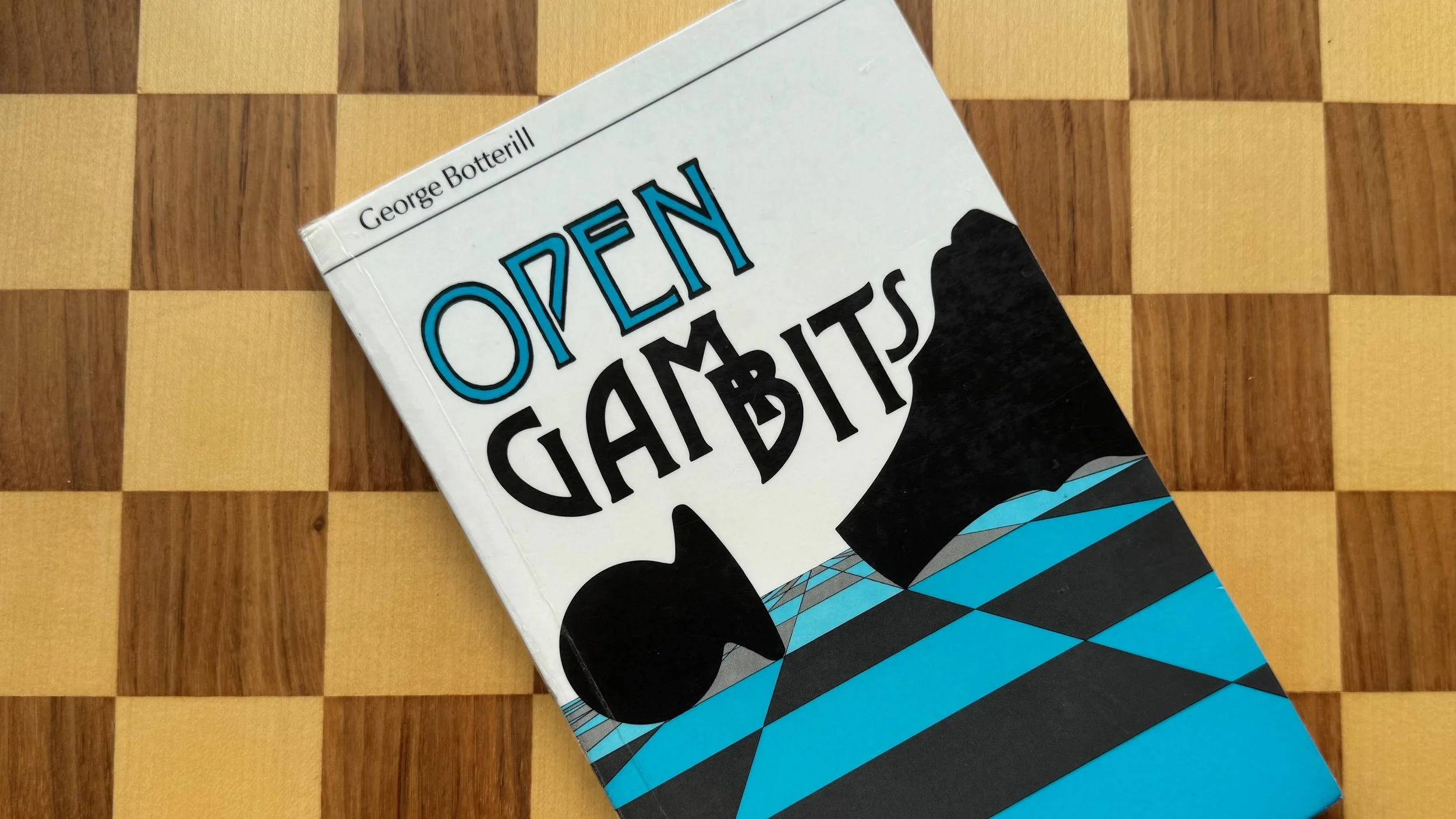
The book is distinctive because of its cover design, which is different from the earlier classic Batsford design (which showed a chess board with the opening position). I believe it was used for three books in the “gambit series” (also Spanish Gambits, King’s Gambit).
It provides coverage of four openings:
- Greco Gambit (in the Italian opening)
- Evans Gambit (also part the Italian opening)
- Scotch Gambit (often transposes to the Italian or the Two Knights)
- Göring Gambit
The book discusses the history of each line and then works through selected variations. I would consider these to be illustrative rather than comprehensive examinations of the opening. Also it should be remembered that this book pre-dates engine analysis. I am sure working through the book with the ruthless machine would identify many errors of assessment and missed possibilities.
To my mind though, treating this as a “reference book” would be missing the point. As Botterill says in the introduction “From the positional point of view we are on the nursery slopes”. These lines and games demonstrate tactical and attacking chess in its purest form. An improving club player could work through the book an learn a great deal about attacking the uncastled king, playing in positions with an open centre and the pros and cons of a development advantage (versus a material deficit). To give an idea of the scope of games, in the section on the Evans Gambit, Botterill gives the well known Anderssen - Dufresne, Berlin 1851 (the “Evergreen”) but also the excellent Wedberg - Kaiszauri, Stockholm 1981 which I had not seen before and shows a successful attack in the context of a modern game.
If you want to learn the openings there are better more modern alternatives (for example “The Evans Gambit” by Andrew Martin, Popular Chess 2026). As a collection of exciting and interesting chess it is a worthy resource. I enjoyed rediscovering the book and its treasures within. The rest of the club will experience this as I have extracted positions for our theme tournament!
Kevin
This article was originally published on www.oldchessnut.co.uk